Introduction
Privacy has become increasingly important in hotels, rental properties, offices, vehicles, dormitories, and homes. Modern electronic devices can be extremely small, and wireless technology allows many devices to communicate without obvious cables or visible connections. For travelers and privacy-conscious users, this has created interest in tools designed to identify unusual radio-frequency activity, camera lenses, and certain types of tracking devices.
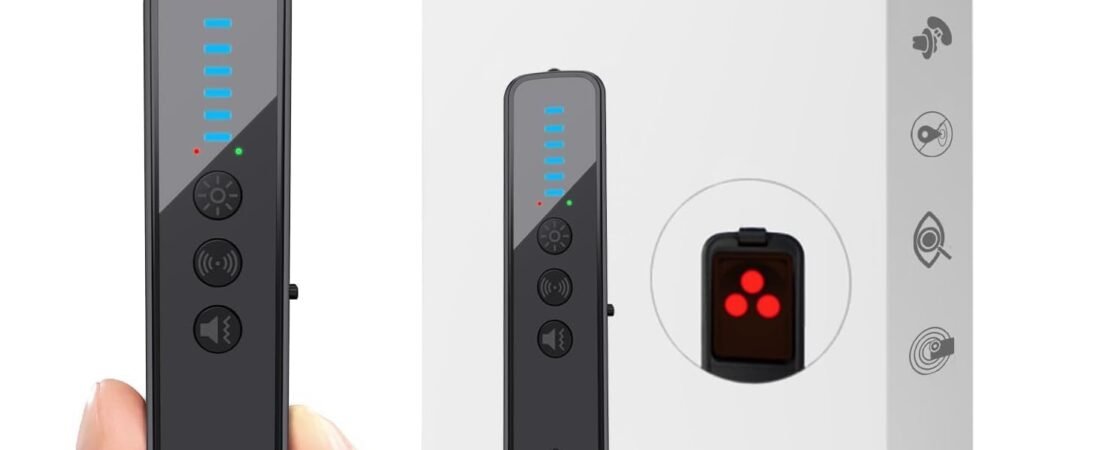
The abyliee Upgraded Hidden Camera Detector, model P18-8G-V3, is a compact electronic detection device designed for this general purpose. The product combines several detection approaches in one portable unit, including radio-frequency signal detection, infrared-assisted hidden-camera lens scanning, and magnetic-field detection intended to help identify certain GPS trackers or other magnetically attached electronic devices. The accompanying documentation also describes audible and LED alerts, adjustable RF sensitivity, vibration operation, a flashlight, and a rechargeable USB Type-C charging connection.
The device is marketed for environments such as hotels, offices, homes, vehicles, and travel situations. Its small dimensions—approximately 3.18 × 0.76 × 0.56 inches according to available product specifications—make it suitable for carrying in a small bag or pocket.
However, an electronic detector should be understood as a screening tool rather than an absolute guarantee of privacy. No consumer detector can reasonably be expected to identify every possible camera, recorder, transmitter, or tracker under every condition. Some devices do not transmit continuously, some operate without radio communication, and ordinary electronics can produce signals that resemble the activity a detector is designed to identify.
Understanding those limitations is just as important as understanding the features.
This guide explains how the abyliee detector works, what its different detection modes are intended to do, how it can be incorporated into a privacy-checking routine, and what users should consider before relying on it.
Key Features
Multi-Mode Detection
One of the main characteristics of the P18-8G-V3 is its combination of several detection methods.
The product documentation identifies three primary modes:
- RF signal detection
- Infrared-assisted camera detection
- Magnetic-field detection
These approaches look for different characteristics, so they should not be treated as interchangeable.
RF detection is concerned with radio-frequency emissions. Infrared-assisted scanning is intended to make certain camera lenses easier to visually identify. Magnetic detection looks for magnetic fields that may be associated with certain devices, particularly small trackers or electronics attached using magnets.
Using several methods can be useful because a potential surveillance device does not necessarily reveal itself in the same way as another device.
RF Signal Scanning
Radio-frequency scanning is intended to identify wireless transmissions in the surrounding area.
A hidden camera that transmits video over Wi-Fi, cellular networks, or another wireless technology may generate RF activity. Similarly, some listening devices, transmitters, or other wireless electronics can produce detectable signals.
The P18-8G-V3 includes an RF detection mode and a sensitivity adjustment control. Its documentation describes LED indicators that provide information about detected signal intensity.
The important point is that an RF detector does not automatically know whether a signal is legitimate or suspicious.
A hotel room can contain numerous wireless devices, including Wi-Fi routers, smartphones, Bluetooth accessories, smart televisions, wireless speakers, and other electronics. All of these can generate RF activity.
Consequently, an RF alert should normally be treated as something to investigate rather than proof that a surveillance device has been found.
Adjustable Sensitivity
The detector includes a signal-strength adjustment button for changing RF sensitivity.
Sensitivity adjustment can be useful in environments with a high amount of normal wireless activity.
For example, a room containing a Wi-Fi router may generate a strong RF response. Reducing sensitivity can help make a sweep more manageable, while increasing sensitivity can be useful when checking areas farther from obvious sources.
A systematic sweep generally provides more useful information than simply turning the detector on and walking around randomly.
Infrared-Assisted Hidden Camera Detection
The device also incorporates infrared lights and a viewing finder intended to assist with identifying camera lenses. The manual identifies dedicated AI infrared lights and a viewfinder for visually scanning for hidden camera lenses.
The basic principle is different from RF scanning.
Instead of searching for a wireless transmission, the user looks for the optical characteristics of a camera lens. Infrared illumination can make reflective lens elements easier to notice under suitable conditions.
This method can be particularly relevant because a camera does not necessarily need to transmit continuously to record video. A camera could potentially store information locally, meaning that RF scanning alone would not necessarily reveal it.
For this reason, visual lens inspection can complement RF detection.
Magnetic Detection
The P18-8G-V3 also provides magnetic-field detection. The manufacturer documentation describes this mode as part of its multi-mode approach and identifies a magnet-mode indicator.
Magnetic detection can be useful when looking for small electronic devices that incorporate magnets, including some types of vehicle tracking equipment.
However, this feature should not be interpreted as a universal GPS-tracker detector.
Not every tracking device uses a strong magnet. Some trackers may be installed using screws, adhesive, cable ties, or other mounting methods. A tracker that is inactive or physically shielded may also behave differently from an actively operating device.
Audible and Visual Alerts
The detector can provide alerts through sound and LED indicators. The user manual also identifies a switch between audible and vibration modes.
Audible alerts can be useful in ordinary environments, while vibration mode can be more discreet when conducting a privacy check in a public or shared setting.
Visual indicators can also help the user monitor changing signal intensity while moving around a room.
Vibration Mode
A silent vibration mode can be practical when users do not want an audible alert.
For example, someone conducting a quick inspection of a hotel room may prefer to avoid repeatedly producing sounds while moving around the room.
Vibration can also be useful when testing an area where other people are present.
The exact interpretation of the vibration response still depends on the detection mode and surrounding environment. It should not automatically be interpreted as evidence that a hidden device is present.
Built-In Flashlight
The unit includes a flashlight according to the user manual.
This is a relatively simple feature, but it can be helpful during physical inspections.
Dark spaces behind furniture, under desks, around ventilation areas, or underneath vehicle components can be difficult to inspect visually. A built-in light gives the user an additional illumination source without requiring a separate flashlight.
Rechargeable Design
The P18-8G-V3 uses an internal rechargeable power system and includes a Type-C charging cable according to its documentation.
Rechargeability makes the device practical for travel because the user does not need to keep disposable batteries on hand.
For people who intend to carry it regularly, maintaining a reasonable charge before travel is important. A detection device with an empty battery is of little use when a room inspection is needed.
Compact Construction
Available specifications list the device at approximately 3.18 × 0.76 × 0.56 inches and around 0.96 ounces.
That small size makes the device relatively easy to carry alongside travel accessories.
It can fit into a backpack, luggage compartment, desk drawer, or small electronics pouch without taking up much space.
How It Can Be Used
Checking a Hotel Room
One of the most obvious applications is a hotel-room privacy check.
A sensible inspection can involve several stages rather than relying on a single detection mode.
First, visually examine the room. Pay attention to objects positioned toward beds, seating areas, bathrooms, desks, and other places where a camera could theoretically be pointed.
Next, the RF mode can be used to identify unusual wireless activity.
The user can then investigate areas where the detector shows a stronger response, while remembering that ordinary wireless electronics can create signals too.
The infrared viewing function can provide a second method of inspection for potential camera lenses.
Finally, magnetic detection can be used around appropriate objects or locations where a magnetically attached device could potentially be positioned.
The goal is not to treat every alert as proof of surveillance. Instead, the process provides multiple ways to investigate unusual equipment.
Rental Properties and Short-Term Accommodation
The same process can be applied to vacation rentals, furnished apartments, dormitories, or other temporary accommodation.
Because users may be unfamiliar with the electronics installed in a property, the first step should always be understanding the normal technology present.
Wi-Fi equipment, smart televisions, smart speakers, security equipment, and other legitimate electronics can produce signals or reflections.
Documenting obvious devices mentally or physically before conducting the scan can make later results easier to interpret.
Checking a Vehicle
The magnetic detection mode can be relevant when inspecting a vehicle for certain types of externally or internally attached tracking devices.
Potential inspection locations can include accessible areas around the vehicle where a magnetic device could physically attach.
However, vehicle inspections have an important limitation: many areas are difficult to access without tools or mechanical knowledge.
A consumer detector should not encourage users to crawl under unsafe vehicles or interfere with mechanical components.
If there is a legitimate concern about unauthorized tracking, a professional automotive or security inspection may be more appropriate.
Home Privacy Checks
The device can also be used in a home environment.
Possible areas include bedrooms, home offices, living spaces, garages, and other rooms containing personal information.
Because homes usually contain many wireless devices, RF scanning can be particularly challenging.
A useful approach is to understand the normal RF environment first.
For example, identify the location of the household Wi-Fi router and other obvious wireless devices. Then observe how the detector behaves around those known sources.
This can help users understand the device’s response before investigating less familiar objects.
Office Environments
Offices can contain a dense mixture of wireless technology.
Wi-Fi access points, laptops, Bluetooth peripherals, wireless conference equipment, printers, phones, and smart devices can all contribute to RF activity.
Consequently, a workplace scan should be conducted systematically and with appropriate authorization.
A privacy detector should never be used as a justification for accessing another person’s property, equipment, desk, bag, or vehicle without permission.
Travel Preparation
The device can be included in a travel electronics kit.
Before leaving home, the user can confirm that the detector is charged and functioning. This is preferable to discovering an empty battery after arriving at a hotel.
A small routine can include:
- Charge the detector.
- Pack the Type-C cable.
- Review the basic operating modes.
- Test the device around known electronics.
- Keep the detector accessible rather than buried in checked luggage if it is intended for immediate use.
This makes it easier to perform a consistent inspection after arriving at a new location.
A Practical Room-Scanning Routine
A structured procedure can help reduce confusion.
Step 1: Start With a Visual Inspection
Before activating electronic detection, look around the room.
Check objects that appear unusually positioned or that have an unexplained opening, lens-like surface, or electronic component.
Common household objects can contain cameras, so visual context matters.
Step 2: Identify Normal Wireless Sources
Locate obvious sources such as routers, smart displays, televisions, phones, and other connected devices.
Knowing where legitimate signals originate can help prevent unnecessary concern about normal RF activity.
Step 3: Use RF Detection
Activate the RF mode and adjust sensitivity according to the environment.
Move methodically through the room rather than waving the detector randomly.
If the signal becomes stronger near a particular location, investigate that area more closely.
Step 4: Use the Lens-Finding Function
Dim lighting can make certain reflective surfaces easier to inspect.
Use the device’s infrared-assisted viewfinder to check suspicious objects and surfaces.
Look for unusual reflections or bright optical points rather than assuming that every reflection represents a camera.
Step 5: Check Appropriate Magnetic Areas
Use magnetic detection where a magnetically mounted device could reasonably be placed.
In a vehicle, this may involve accessible exterior or interior locations. In a room, it could involve objects where magnetic mounting would make sense.
Step 6: Investigate Before Drawing Conclusions
A detector alert is a signal for investigation, not a final diagnosis.
Compare the response with known electronic equipment.
If something remains unexplained and there is a genuine privacy concern, consider documenting the object and contacting the appropriate property manager, security professional, or law-enforcement authority depending on the circumstances.
Who It May Be Suitable For
Frequent Travelers
People who regularly stay in hotels, rental properties, or temporary accommodation may appreciate having a compact privacy-screening device available.
Privacy-Conscious Individuals
People who take additional steps to understand the technology around them may use a detector as part of a broader privacy routine.
Business Travelers
Professionals carrying confidential information may want to pay closer attention to the privacy characteristics of temporary workspaces.
Vehicle Owners
The magnetic detection function may be relevant to users concerned about unauthorized tracking devices attached to accessible areas of a vehicle.
Home Users
A household may keep the detector available for occasional privacy checks, particularly after moving into a new property or installing unfamiliar connected equipment.
Security and Technology Enthusiasts
People interested in RF technology, electronic detection, and privacy equipment may find a multi-mode detector useful as a learning tool.
That said, users conducting professional counter-surveillance work generally require equipment with more detailed technical specifications, calibration procedures, and specialized capabilities.
Important Things to Consider
Detection Is Not Proof
This is perhaps the most important limitation.
A signal detected by an RF scanner does not automatically mean that a hidden camera or listening device is present.
Wi-Fi routers, smartphones, Bluetooth devices, wireless keyboards, smart home equipment, and other legitimate electronics can produce RF activity.
The detector can help identify an area that deserves further investigation, but the user must interpret the result in context.
Not Every Camera Transmits Wirelessly
A camera can potentially store footage locally rather than transmitting it continuously.
An RF detector may therefore not detect a camera that is not actively transmitting.
This is one reason the infrared-assisted visual inspection mode can complement RF scanning.
Not Every GPS Tracker Is Magnetically Mounted
Magnetic detection has a specific purpose and should not be interpreted as universal tracker detection.
A GPS device can be installed using various mounting methods.
The absence of a magnetic response does not establish that a tracking device is absent.
Wireless Interference Can Affect Results
RF environments vary considerably.
Urban hotels, offices, airports, apartment buildings, and technology-heavy homes can contain many wireless signals.
A detector may respond to legitimate sources or produce different readings depending on distance and interference.
Users should become familiar with the detector around known sources before relying on it for more meaningful inspections.
Physical Inspection Still Matters
Electronic detection should complement physical observation rather than replace it.
Look at unusual objects, modified electronics, unexpected wires, unfamiliar adapters, and devices that seem inconsistent with the environment.
A combination of physical observation and electronic scanning provides more context than either method alone.
Professional Inspection May Be Appropriate
If a person has a serious and specific concern about surveillance, a consumer detector may not be sufficient.
Professional counter-surveillance specialists can use specialized RF spectrum-analysis equipment, optical inspection equipment, network analysis, physical examination, and other methods.
The appropriate response depends on the circumstances and the level of risk involved.
Avoid Unsafe Vehicle Inspections
Vehicle inspections can involve traffic, hot components, moving parts, electrical systems, and areas that require lifting equipment.
A small consumer detector does not eliminate those hazards.
Do not place yourself underneath an unsupported vehicle or interfere with components simply to search for a tracking device.
Respect Privacy and Property Rights
A privacy detector should be used responsibly.
Users should not search another person’s personal belongings, vehicle, office, or private space without appropriate permission.
The technology is intended to support legitimate privacy checks, not unauthorized access or surveillance.
Comparison of General Detection Categories
Basic RF Detectors
Basic RF detectors generally focus primarily on identifying radio-frequency energy.
They can be relatively straightforward to operate, but their usefulness depends heavily on how the user interprets the detected signals.
A simple RF detector may not provide additional optical or magnetic inspection capabilities.
Multi-Mode Consumer Detectors
Multi-mode devices combine RF scanning with additional methods such as infrared lens detection or magnetic sensing.
The abyliee P18-8G-V3 belongs to this general category.
The advantage of combining modes is that users can investigate different characteristics of a potential device without carrying several separate instruments.
The trade-off is that consumer multi-mode equipment should not automatically be treated as equivalent to specialized professional counter-surveillance equipment.
Smartphone-Based Detection Apps
Smartphones can be used with applications that attempt to identify nearby devices, magnetic fields, networks, or other indicators.
These can be convenient because no separate hardware is required.
However, smartphone sensors and software have inherent limitations, and an app cannot necessarily reproduce the capabilities of dedicated RF or optical detection hardware.
Professional Counter-Surveillance Equipment
Professional equipment can include spectrum analyzers, specialized RF receivers, optical inspection systems, non-linear junction detectors, network-analysis tools, and other specialized technologies.
Such equipment is intended for more demanding investigations and usually requires greater technical knowledge.
For ordinary travel and household screening, a compact consumer detector serves a different purpose.
Frequently Asked Questions
What does the abyliee hidden camera detector detect?
The P18-8G-V3 documentation describes RF signal detection, infrared-assisted hidden-camera lens detection, and magnetic-field detection. It is marketed for identifying potential hidden cameras, wireless devices, and certain tracking devices.
Does this device guarantee that a room is free from hidden cameras?
No. A consumer detector cannot guarantee that a room contains no hidden surveillance equipment.
Some cameras may not transmit wirelessly, some devices may be inactive, and physical conditions can affect detection.
The device should therefore be treated as a screening and inspection aid rather than a guarantee of privacy.
Does the detector use AI?
The product is marketed as having AI-powered detection, and available product documentation describes the P18-8G-V3 using that terminology.
However, users should not interpret the word “AI” as meaning the device can definitively identify every surveillance device automatically. Detection still depends on the underlying sensors, signal conditions, operating mode, and the user’s interpretation of the results.
Can it detect Wi-Fi cameras?
An actively transmitting Wi-Fi camera can potentially produce RF activity that falls within the type of wireless activity an RF detector is intended to identify.
However, the presence of an RF signal does not prove that it comes from a camera. Conversely, a camera that is not transmitting may not produce a detectable RF signal.
Can it detect a GPS tracker?
The device includes magnetic-field detection intended to help identify certain types of GPS trackers and other magnetic electronic devices.
It should not be assumed that every GPS tracker will be detected, particularly if the device does not use a magnetic mounting method or is not producing detectable activity.
Can it detect audio bugs?
The manufacturer describes the device as suitable for detecting listening devices and other covert surveillance equipment.
In practice, detection depends on the characteristics of the device being investigated. A wireless transmitter may be detectable through RF activity, while a passive recorder that stores audio locally may not produce the same detectable signal.
How should I use the detector in a hotel?
Begin with a visual inspection and identify obvious wireless equipment. Then conduct a systematic RF scan, investigate stronger or unexplained responses, and use the infrared lens-finding function to examine suspicious objects.
Avoid interpreting a single alert as proof of surveillance.
Can I use it in a car?
Yes. The product is marketed for vehicle-related privacy checks, and magnetic detection can be useful for certain types of trackers.
Vehicle inspections should be performed safely, and difficult-to-access mechanical areas should be left to qualified professionals.
Is the detector rechargeable?
Yes. The documentation identifies a rechargeable design and a Type-C charging port.
Is it portable?
The device is designed as a compact handheld detector. Available specifications list dimensions of approximately 3.18 × 0.76 × 0.56 inches and a weight of roughly 0.96 ounces.
Does it make a sound when it detects something?
The manual describes audible alerts and a switch that allows the user to select audible or vibration operation.
Can the detector identify exactly what device is transmitting?
Users should not expect a simple consumer detector to identify every RF source by name.
It can indicate signal activity or changes in detection strength, but determining exactly what produced the signal may require additional investigation or professional equipment.
What is included with the device?
The available user manual lists the detector itself, a Type-C charging cable, and a user manual.
Is it suitable for professional security investigations?
The device can be useful as a consumer screening tool, but professional counter-surveillance work may require specialized equipment, technical training, calibration, and procedures beyond the capabilities of a compact consumer detector.
Conclusion
The abyliee Upgraded Hidden Camera Detector is designed to combine several privacy-screening functions in a compact handheld device. The P18-8G-V3 provides RF signal detection, infrared-assisted camera-lens inspection, magnetic-field detection, adjustable sensitivity, audible and vibration alerts, LED indicators, a flashlight, and rechargeable USB Type-C operation.
These features give users several ways to examine their surroundings rather than depending exclusively on one type of detection.
For travelers, the device can be incorporated into a hotel or rental-property inspection routine. At home or in an office, it can provide an additional method for investigating unfamiliar electronics or wireless activity. In a vehicle, its magnetic detection function may help identify certain magnetically mounted tracking devices.
At the same time, responsible use requires understanding the limitations of the technology. RF signals are not automatically evidence of surveillance, because ordinary electronics also transmit radio-frequency energy. Not every camera communicates wirelessly, and not every tracking device is magnetically mounted. Environmental interference can also affect detection.
The most useful approach is therefore a combination of methods: physical observation, knowledge of normal electronics in the environment, RF scanning, optical inspection, and magnetic detection where appropriate. When a genuine security concern remains unresolved, professional assistance may be more appropriate than relying solely on a consumer device.
For users interested in carrying a compact multi-mode privacy-screening tool for travel, home, office, or vehicle inspections,
you can check more details on Amazon here.
Amazon Associates Disclosure: As an Amazon Associate, we earn from qualifying purchases.